
BREAKING NEWS
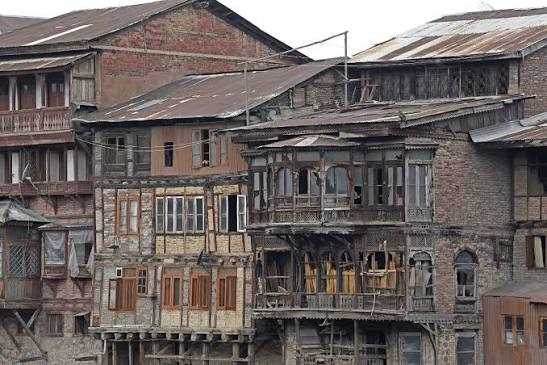
Srinagar, Aug 19: For 55-year-old Rafeeqa, home offers little of the comfort or privacy a family needs. She lives with 12 members of her extended family in a fragile two-storey house in Nawakadal, where three families share cramped rooms, a small kitchen and a single bathroom.
Her daughters-in-law reach their rooms through a dilapidated wooden ladder, highlighting the difficult living conditions faced by many families in Srinagar’s densely populated Downtown.
“We are three families comprising 12 members. Two rooms are reached by a damaged wooden ladder, while a small space serves as the kitchen and we all share one bathroom,” Rafeeqa said.
Her experience reflects a wider housing challenge in Srinagar’s Old City, where narrow lanes, ageing structures and high population density have left many families living in overcrowded and poorly ventilated homes.
Srinagar has grown dramatically over the past century. According to the Srinagar Master Plan 2035, the city and its expanded areas cover around 766 square kilometres and have a population of more than 12 lakh. The city’s population increased from 1,22,618 in 1901 to 12,25,837 in the 2011 Census.
Housing pressure is particularly acute in the Downtown area. Census 2011 data cited in the Master Plan show that nearly 10 per cent of residents live in one-room accommodation and around 18 per cent in two-room homes. The Srinagar Metropolitan Region was estimated to have a net housing shortage of about four per cent of dwelling units.
But the crisis is not simply about numbers. It is also about the quality, safety and dignity of housing.
A study published in the Journal of Geography and Regional Planning found extremely high household density in parts of Downtown, with more than 7,000 households per square kilometre. It noted that many residents live in decaying, overcrowded structures with inadequate civic and sanitation facilities.
Government housing schemes have provided some relief. Under the Pradhan Mantri Awas Yojana-Urban (PMAY-U), Jammu and Kashmir has sanctioned houses for 42,585 beneficiaries, with 34,255 reportedly completed, according to the Economic Survey 2025-26.
In Srinagar, 3,809 houses have been sanctioned and 3,271 completed. Officials said eligible families receive around Rs 2.20 lakh to construct a two-room house with a kitchen and bathroom.
However, residents say the benefits have not adequately reached families living in the most congested parts of the Old City.
For low-income households dependent on daily wages, the sharp rise in land and construction costs has made owning or rebuilding a home increasingly difficult.
“People in the Old City live in cramped spaces with poor ventilation and sanitation, yet many are not benefiting from housing schemes,” said resident Faheem Shakeel.
Another resident, Lateef Ahmad Bhat, urged the government to provide land or affordable housing to families unable to construct homes themselves.
“Housing has become a social issue in Srinagar,” he said.
The issue has also reached the political leadership. National Conference legislators Salman Sagar and Shamima Firdous said they had raised the housing crisis with Chief Minister Omar Abdullah, who also holds the Housing and Urban Development portfolio.
Sagar called for a long-term rehabilitation and relocation policy for families living in extremely small or unsafe houses, suggesting that eligible households could be provided land or suitable accommodation.
Firdous said many families were living in structures that could barely be described as proper houses, with multiple households sharing kitchens and bathrooms. She favoured a policy offering land or housing to the most vulnerable families.
The legislators said some immediate assistance was also being provided through constituency development funds for basic repairs and facilities.
The Srinagar Master Plan 2035 has proposed developing satellite townships around Ganderbal, Bemina, Pampore and Budgam, besides dormitory townships at Nowgam, Lawaypora and Zakura. Such expansion could ease pressure on the congested core city while creating new housing options.
For Srinagar, however, building new houses alone will not solve the problem. The city needs a coordinated strategy combining affordable housing, rehabilitation of vulnerable families, infrastructure upgrades, improved connectivity and planned urban expansion.
For families like Rafeeqa’s, the issue cannot wait for another master plan.
A home should provide security, privacy and dignity—not merely shelter. Srinagar’s housing crisis is therefore ultimately a human problem, demanding a practical, time-bound and compassionate response from the government.
Srinagar, Aug 19: For 55-year-old Rafeeqa, home offers little of the comfort or privacy a family needs. She lives with 12 members of her extended family in a fragile two-storey house in Nawakadal, where three families share cramped rooms, a small kitchen and a single bathroom.
Her daughters-in-law reach their rooms through a dilapidated wooden ladder, highlighting the difficult living conditions faced by many families in Srinagar’s densely populated Downtown.
“We are three families comprising 12 members. Two rooms are reached by a damaged wooden ladder, while a small space serves as the kitchen and we all share one bathroom,” Rafeeqa said.
Her experience reflects a wider housing challenge in Srinagar’s Old City, where narrow lanes, ageing structures and high population density have left many families living in overcrowded and poorly ventilated homes.
Srinagar has grown dramatically over the past century. According to the Srinagar Master Plan 2035, the city and its expanded areas cover around 766 square kilometres and have a population of more than 12 lakh. The city’s population increased from 1,22,618 in 1901 to 12,25,837 in the 2011 Census.
Housing pressure is particularly acute in the Downtown area. Census 2011 data cited in the Master Plan show that nearly 10 per cent of residents live in one-room accommodation and around 18 per cent in two-room homes. The Srinagar Metropolitan Region was estimated to have a net housing shortage of about four per cent of dwelling units.
But the crisis is not simply about numbers. It is also about the quality, safety and dignity of housing.
A study published in the Journal of Geography and Regional Planning found extremely high household density in parts of Downtown, with more than 7,000 households per square kilometre. It noted that many residents live in decaying, overcrowded structures with inadequate civic and sanitation facilities.
Government housing schemes have provided some relief. Under the Pradhan Mantri Awas Yojana-Urban (PMAY-U), Jammu and Kashmir has sanctioned houses for 42,585 beneficiaries, with 34,255 reportedly completed, according to the Economic Survey 2025-26.
In Srinagar, 3,809 houses have been sanctioned and 3,271 completed. Officials said eligible families receive around Rs 2.20 lakh to construct a two-room house with a kitchen and bathroom.
However, residents say the benefits have not adequately reached families living in the most congested parts of the Old City.
For low-income households dependent on daily wages, the sharp rise in land and construction costs has made owning or rebuilding a home increasingly difficult.
“People in the Old City live in cramped spaces with poor ventilation and sanitation, yet many are not benefiting from housing schemes,” said resident Faheem Shakeel.
Another resident, Lateef Ahmad Bhat, urged the government to provide land or affordable housing to families unable to construct homes themselves.
“Housing has become a social issue in Srinagar,” he said.
The issue has also reached the political leadership. National Conference legislators Salman Sagar and Shamima Firdous said they had raised the housing crisis with Chief Minister Omar Abdullah, who also holds the Housing and Urban Development portfolio.
Sagar called for a long-term rehabilitation and relocation policy for families living in extremely small or unsafe houses, suggesting that eligible households could be provided land or suitable accommodation.
Firdous said many families were living in structures that could barely be described as proper houses, with multiple households sharing kitchens and bathrooms. She favoured a policy offering land or housing to the most vulnerable families.
The legislators said some immediate assistance was also being provided through constituency development funds for basic repairs and facilities.
The Srinagar Master Plan 2035 has proposed developing satellite townships around Ganderbal, Bemina, Pampore and Budgam, besides dormitory townships at Nowgam, Lawaypora and Zakura. Such expansion could ease pressure on the congested core city while creating new housing options.
For Srinagar, however, building new houses alone will not solve the problem. The city needs a coordinated strategy combining affordable housing, rehabilitation of vulnerable families, infrastructure upgrades, improved connectivity and planned urban expansion.
For families like Rafeeqa’s, the issue cannot wait for another master plan.
A home should provide security, privacy and dignity—not merely shelter. Srinagar’s housing crisis is therefore ultimately a human problem, demanding a practical, time-bound and compassionate response from the government.

© Copyright 2023 brighterkashmir.com All Rights Reserved. Quantum Technologies