
BREAKING NEWS
The consequences of this approach have not been limited to Mumbai. South Asia has repeatedly witnessed attacks attributed to Pakistan-based militant organizations. The 2001 attack on the Indian Parliament, the 2008 Mumbai massacre and the 2019 Pulwama suicide bombing are among the most consequential incidents associated with militant networks operating in the region
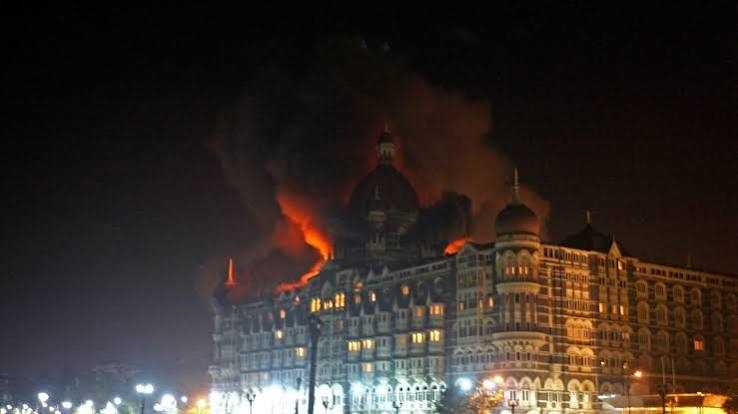
On the night of 26 November 2008, Mumbai was not merely attacked; its ordinary life was transformed into a theatre of calculated terror. Commuters at Chhatrapati Shivaji Terminus, diners at Leopold Café, guests at the Taj Mahal Palace and Oberoi hotels, and people gathered at Nariman House became targets in an assault designed to wound an entire nation. For nearly three days, ten heavily armed gunmen held Mumbai and the world hostage. When the violence finally ended, 166 innocent people had lost their lives and hundreds were injured. The victims were not participants in a war, nor were they combatants in any ideological struggle. They were ordinary people whose only misfortune was being in the wrong place when an organization decided that human lives could be sacrificed to advance its political ambitions.
The 26/11 attack was not an impulsive act of violence. It was a carefully planned terrorist operation whose roots lay across the border in Pakistan. The evidence established that the attackers belonged to Lashkar-e-Taiba, a Pakistan-based terrorist organization. They travelled from Karachi by sea, hijacked an Indian fishing vessel, murdered its crew and entered Mumbai through its coastline. The capture of Ajmal Kasab, the sole surviving attacker, provided crucial evidence about the operation, its preparation and its handlers. Intercepted communications during the siege revealed individuals based in Pakistan directing the gunmen, monitoring their movements and instructing them on targets. Investigations by Indian and international agencies established that the attack had been planned, trained for and launched from Pakistani territory. The responsibility of Pakistan's military establishment and its security apparatus cannot be brushed aside through the convenient argument that these were merely non-state actors. Terrorist organizations do not develop sophisticated operational capabilities, training facilities, recruitment networks and financial structures in a political vacuum.
When organizations such as Lashkar-e-Taiba are permitted to maintain infrastructure, regroup under different names and continue their activities despite official bans, questions about state complicity, institutional protection and deliberate negligence become unavoidable. The precise extent of involvement of serving or former intelligence personnel has not been conclusively established through a public judicial process. Nevertheless, the evidence concerning the organization’s Pakistan-based infrastructure and the failure to bring the principal alleged masterminds to justice has left Pakistan with a profound credibility deficit. Pakistan's political establishment has repeatedly attempted to separate itself from the actions of terrorist organizations operating from its territory.
Yet a government cannot indefinitely deny responsibility for an ecosystem that repeatedly produces organizations dedicated to violence beyond its borders. Lashkar-e-Taiba was formally banned, but its affiliated networks and successor platforms have continued to attract scrutiny. Its founder, Hafiz Saeed, has faced detention and prosecution, but the larger question of dismantling the organization’s operational and ideological infrastructure remains unresolved. The same concern extends to Jaish-e-Mohammed and other militant organizations that have been accused of carrying out attacks against India.
The Pakistani army occupies an extraordinary position in the country's political and security architecture. Its influence extends far beyond conventional military responsibilities, shaping foreign policy, strategic priorities and the country's approach towards India. This makes its responsibility particularly significant. If militant organizations have been viewed by sections of the establishment as instruments of strategic influence, the consequences have been devastating for the entire region. Such a policy does not represent national strength; it represents a dangerous dependence on violence as an instrument of statecraft. It undermines diplomacy, damages regional stability and perpetuates an atmosphere in which innocent civilians remain vulnerable to ideological extremism.
The consequences of this approach have not been limited to Mumbai. South Asia has repeatedly witnessed attacks attributed to Pakistan-based militant organizations. The 2001 attack on the Indian Parliament, the 2008 Mumbai massacre and the 2019 Pulwama suicide bombing are among the most consequential incidents associated with militant networks operating in the region. Jaish-e-Mohammed claimed responsibility for the Pulwama attack, which killed forty Indian security personnel. Each incident has deepened mistrust and strengthened the perception that Pakistan's counterterrorism commitments have been inconsistent and selective. The international community has repeatedly called upon Pakistan to dismantle terrorist financing, recruitment and operational networks. Such demands are not expressions of hostility towards the Pakistani population; they are demands for accountability from a state whose policies have consequences far beyond its geographical boundaries.
However, the contradiction within Pakistan's political narrative becomes even more visible when one looks towards Pakistan-administered Jammu and Kashmir. For decades, Pakistan has projected itself internationally as the champion of Kashmiri rights. Yet the voices emerging from within the territory it administers reveal a different and uncomfortable reality. People there have increasingly demanded affordable electricity, subsidized flour, economic justice, accountable governance, political representation and greater control over their natural resources. These are not extravagant demands. They are basic expectations of a population seeking dignity and a meaningful voice in the decisions that determine its future. The Joint Awami Action Committee (JAAC) emerged as a powerful expression of these accumulated grievances. Its movement brought together ordinary residents, traders, workers, students and sections of civil society who were frustrated by economic hardship and political marginalization.
The protests were not simply about electricity tariffs or the price of flour. They reflected a deeper resentment against a system in which people frequently feel that their resources are extracted, their political choices are restricted and their voices are treated as inconvenient disturbances. The response of the authorities has raised serious questions about the nature of governance in Pakistan-administered Kashmir. During the May 2024 protests, confrontations between demonstrators and security personnel resulted in deaths, including those of protesters and a police officer. Amnesty International reported concerns about the use of force, including tear gas and lethal weapons. Further protests in October 2025 again turned deadly, with reports of multiple casualties and hundreds of injuries. In 2026, the confrontation escalated further. Amnesty International raised concerns over mass arrests, internet restrictions, the use of force and the treatment of the JAAC as a prohibited organization\ These developments have intensified fears that legitimate civic grievances are increasingly being approached through the language of security rather than democratic engagement. The authorities have, at various points, accused sections of protesters of violence and attacks on security personnel. Such allegations must be investigated impartially, and violence against civilians or police officers cannot be justified. But allegations against individuals cannot become an excuse for collective punishment. Peaceful assembly, freedom of expression and the right to demand accountability are fundamental rights. A government cannot claim democratic legitimacy while treating every organised expression of public dissatisfaction as a threat to national security. Arrests, communication restrictions and excessive force cannot resolve the economic and political grievances that brought people onto the streets in the first place.
There is a particularly troubling contradiction in Pakistan's position. While its political and military leadership frequently invokes the aspirations of Kashmiris in international forums, the people of Pakistan-administered Kashmir continue to demand greater economic freedom, political representation and accountability from the very administration governing them. Their grievances expose the difference between speaking on behalf of a population and genuinely respecting its political agency. Kashmiris are not instruments of anyone's geopolitical ambitions. Their aspirations cannot be reduced to slogans, diplomatic statements or strategic calculations. The Pakistani army's influence over the region's security and political environment makes it impossible to discuss these developments without examining the larger structure of power.
A military establishment that demands unquestioning loyalty from its citizens while resisting scrutiny of its own decisions creates a deeply unequal relationship between the state and society. The civilian government, meanwhile, cannot escape responsibility by blaming institutional rivalries. It must ensure that peaceful dissent is protected, economic commitments are honoured and allegations of human rights violations are investigated independently. The connection between the tragedy of 26/11 and the grievances of the JAAC must be understood carefully. They are not equivalent events. The Mumbai massacre was an act of organised terrorism directed against innocent civilians. The JAAC movement is an expression of public and political grievances. Peaceful protest must never be equated with terrorism. The connection lies in a broader question of accountability: whether institutions exercise power within the boundaries of law and human dignity, or whether they use coercion to protect themselves from scrutiny. The victims of Mumbai deserve justice against those who planned and executed mass murder. The people of Pakistan-administered Kashmir deserve justice when they demand their economic and political rights. Neither demand should be silenced.
India must remember 26/11 without allowing its grief to become hatred towards ordinary Pakistanis. The Pakistani people are not collectively responsible for the decisions of military commanders, intelligence officials or terrorist organisations. Pakistan itself has suffered immensely from extremist violence, losing thousands of civilians and security personnel. Many Pakistanis have openly opposed terrorism and rejected the use of violence as an instrument of politics. A principled position must distinguish between a population and the institutions or networks responsible for violence. The strongest criticism of Pakistan's military establishment is one grounded in evidence, justice and an unwavering commitment to civilian life. The Pakistani army and government now face a fundamental choice. They can continue to preserve strategic ambiguity, allowing militant organisations to survive while responding coercively to legitimate public grievances. Or they can undertake a genuine transformation: dismantle terrorist infrastructure, prosecute those responsible for 26/11, end support for militant proxies, protect peaceful assembly and provide the people of Pakistan-administered Kashmir with meaningful democratic representation. These are not unreasonable demands. They are the minimum obligations of any state that wishes to be regarded as a responsible member of the international community. More than a decade and a half after the Mumbai siege, the names of the victims remain a reminder of the human cost of state-enabled extremism and institutional impunity. The streets of Pakistan-administered Kashmir, meanwhile, carry another message: people cannot be governed indefinitely through fear, censorship and coercion. The demand for justice in Mumbai and the demand for dignity in Kashmir emerge from different circumstances, but both challenge the same dangerous assumption that those in power can escape accountability.
South Asia has suffered enough from militarised nationalism, proxy warfare and the politics of permanent confrontation. Its future cannot be built upon terrorist organisations operating across borders or governments suppressing the voices of their own people. The Pakistani military establishment must understand that national prestige cannot be secured through militant proxies, and its civilian government must recognise that political legitimacy cannot be maintained through repression. The people of Pakistan-administered Kashmir deserve more than symbolic sympathy, while the families of Mumbai's victims deserve more than diplomatic assurances. Ultimately, the measure of a state is not the fear it can generate, the weapons it possesses or the influence it exercises over neighbouring territories. It is the justice it delivers, the freedoms it protects and the security it guarantees to ordinary people. Until Pakistan confronts the terrorist infrastructure that brought Mumbai to its knees and addresses the legitimate grievances of people living under its administration, its claims of moral leadership on Kashmir will remain deeply compromised. History will remember 26/11 not merely as an attack on Mumbai, but as a warning of what happens when extremism is tolerated, accountability is evaded and human lives become expendable in the pursuit of political power.

© Copyright 2023 brighterkashmir.com All Rights Reserved. Quantum Technologies