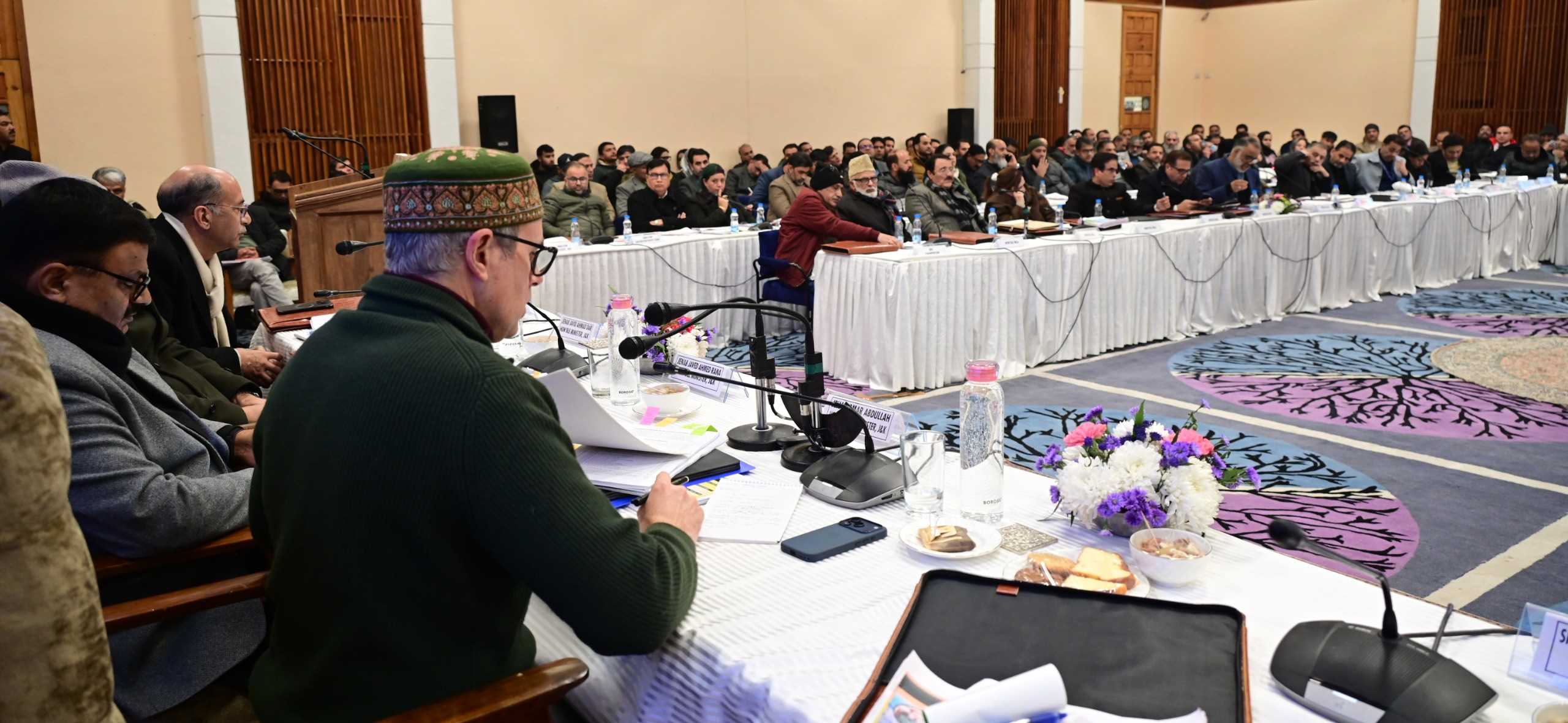
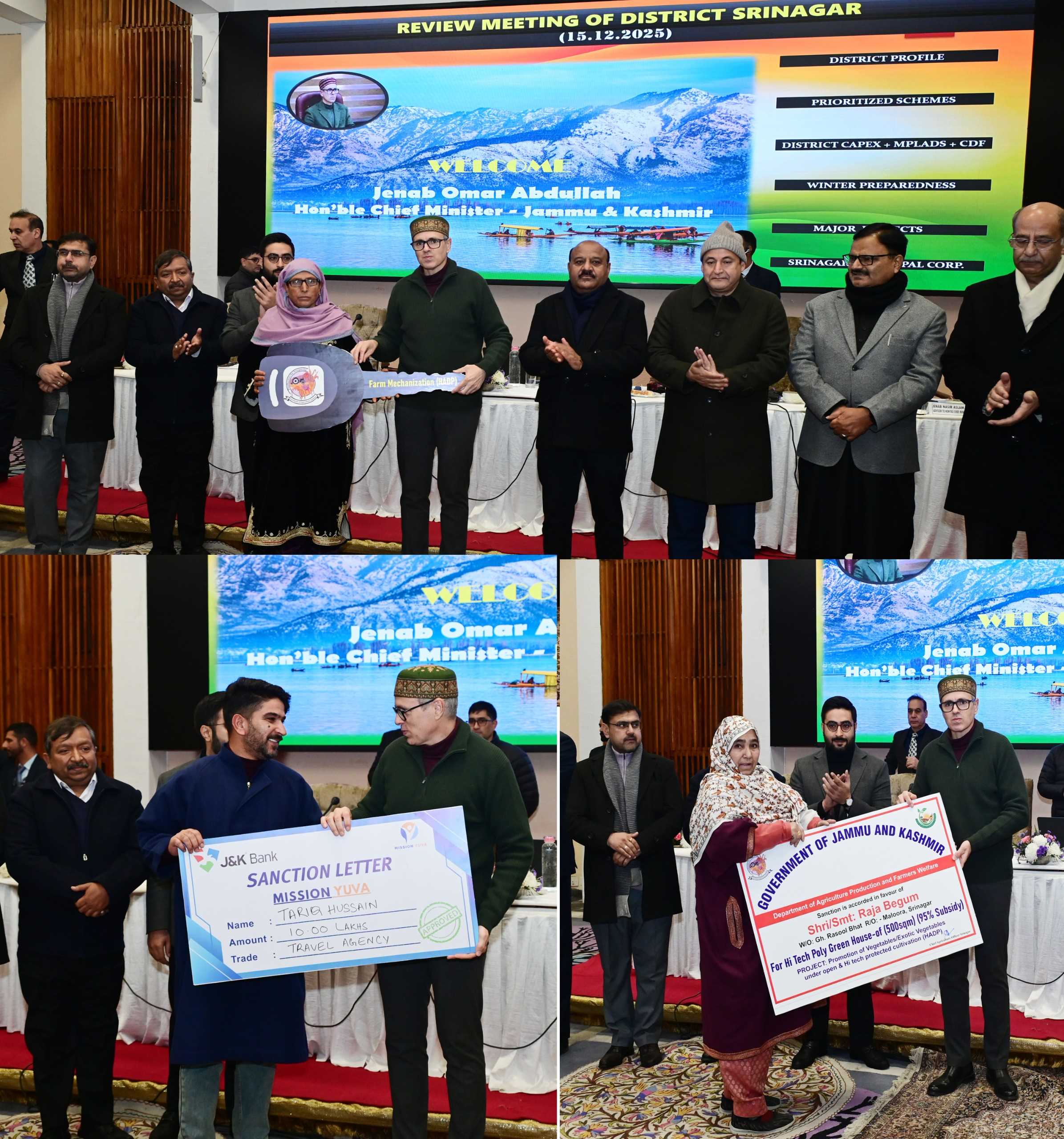
Chief Minister Omar Abdullah today chaired a high-level review meeting at the Sher-i-Kashmir International Conference Centre (SKICC) to assess the overall developmental scenario of Srinagar district and obtain first-hand feedback on public issues from elected representatives.
The meeting undertook a detailed review of sector-wise and Assembly Constituency-wise implementation of government flagship schemes and key development projects being executed under various budgetary components.
Deputy Chief Minister Surinder Kumar Chowdhury, Ministers Javaid Ahmad Rana, Javaid Dar and Satish Sharma, Advisor to the Chief Minister Nasir Aslam Wani, Chairperson District Development Council Srinagar Malik Aftab, and Members of the Legislative Assembly from Srinagar district attended the meeting.
MLAs including Ali Mohammad Sagar, Mubarak Gul, Shameem Firdous, Salman Sagar, Tanvir Sadiq, Ahsan Ahmad Pardesi and Mushtaq Ahmad Guru raised issues related to development and civic amenities in their respective constituencies.
Among senior officials present were Additional Chief Secretary to the Chief Minister Dheeraj Gupta, Divisional Commissioner Kashmir Anshul Garg, Deputy Commissioner Srinagar Akshay Labroo, Commissioner Srinagar Municipal Corporation Faz Lul Haseeb, Director FCS&CA Dr Owais Ahmad, along with Heads of Departments and senior sectoral and district officers.
The Chief Minister assured that concerns raised by the elected representatives would be addressed on priority to ensure responsive and people-centric governance.
The Chief Minister laid special emphasis on the need for a permanent and sustainable solution to the environmental and public health issues arising from the Achan dumping site. He directed the concerned departments to adopt scientific and environmentally sound waste management practices and stressed that the issue must be resolved in a time-bound manner.
Reviewing the traffic situation in Srinagar, the Chief Minister called for long-term and integrated measures to ease congestion. He directed officers to identify and remove critical bottlenecks at major roads and junctions, improve road alignment where land has already been acquired under widening projects, and strengthen coordination among executing agencies to ensure smooth vehicular movement.
Expressing concern over the growing issue of stray dogs, the Chief Minister stressed the adoption of a humane, scientific and legally compliant approach to address the dog menace, emphasising enhanced coordination between municipal authorities and other concerned stakeholders.
The Chief Minister also underscored the importance of active involvement of elected representatives in the planning and execution of development initiatives, stating that their participation is vital for ensuring grassroots feedback, transparency and effective implementation of public welfare programmes.
He directed all departments to maintain close inter-departmental coordination, adhere to prescribed timelines, and ensure that development works translate into tangible benefits for the people of Srinagar.
During the review, the Chief Minister assessed departmental performance in implementing flagship schemes and executing key development projects under District CAPEX and CDF allocations. He emphasised the need to accelerate project execution and ensure timely utilisation of funds, while maintaining close coordination with MLAs to ensure visible outcomes on the ground.
Earlier, Deputy Commissioner Srinagar Akshay Labroo briefed the Chief Minister through a detailed presentation on the district’s developmental scenario, ongoing initiatives and implementation of public-centric government schemes. The Commissioner, Srinagar Municipal Corporation, also presented an overview of key civic initiatives.
The Chief Minister was further apprised of winter preparedness measures put in place by the district administration and Srinagar Municipal Corporation to ensure uninterrupted essential services and public convenience during snowfall and other weather-related challenges

Chief Minister Omar Abdullah today chaired a high-level review meeting at the Sher-i-Kashmir International Conference Centre (SKICC) to assess the overall developmental scenario of Srinagar district and obtain first-hand feedback on public issues from elected representatives.
The meeting undertook a detailed review of sector-wise and Assembly Constituency-wise implementation of government flagship schemes and key development projects being executed under various budgetary components.
Deputy Chief Minister Surinder Kumar Chowdhury, Ministers Javaid Ahmad Rana, Javaid Dar and Satish Sharma, Advisor to the Chief Minister Nasir Aslam Wani, Chairperson District Development Council Srinagar Malik Aftab, and Members of the Legislative Assembly from Srinagar district attended the meeting.
MLAs including Ali Mohammad Sagar, Mubarak Gul, Shameem Firdous, Salman Sagar, Tanvir Sadiq, Ahsan Ahmad Pardesi and Mushtaq Ahmad Guru raised issues related to development and civic amenities in their respective constituencies.
Among senior officials present were Additional Chief Secretary to the Chief Minister Dheeraj Gupta, Divisional Commissioner Kashmir Anshul Garg, Deputy Commissioner Srinagar Akshay Labroo, Commissioner Srinagar Municipal Corporation Faz Lul Haseeb, Director FCS&CA Dr Owais Ahmad, along with Heads of Departments and senior sectoral and district officers.
The Chief Minister assured that concerns raised by the elected representatives would be addressed on priority to ensure responsive and people-centric governance.
The Chief Minister laid special emphasis on the need for a permanent and sustainable solution to the environmental and public health issues arising from the Achan dumping site. He directed the concerned departments to adopt scientific and environmentally sound waste management practices and stressed that the issue must be resolved in a time-bound manner.
Reviewing the traffic situation in Srinagar, the Chief Minister called for long-term and integrated measures to ease congestion. He directed officers to identify and remove critical bottlenecks at major roads and junctions, improve road alignment where land has already been acquired under widening projects, and strengthen coordination among executing agencies to ensure smooth vehicular movement.
Expressing concern over the growing issue of stray dogs, the Chief Minister stressed the adoption of a humane, scientific and legally compliant approach to address the dog menace, emphasising enhanced coordination between municipal authorities and other concerned stakeholders.
The Chief Minister also underscored the importance of active involvement of elected representatives in the planning and execution of development initiatives, stating that their participation is vital for ensuring grassroots feedback, transparency and effective implementation of public welfare programmes.
He directed all departments to maintain close inter-departmental coordination, adhere to prescribed timelines, and ensure that development works translate into tangible benefits for the people of Srinagar.
During the review, the Chief Minister assessed departmental performance in implementing flagship schemes and executing key development projects under District CAPEX and CDF allocations. He emphasised the need to accelerate project execution and ensure timely utilisation of funds, while maintaining close coordination with MLAs to ensure visible outcomes on the ground.
Earlier, Deputy Commissioner Srinagar Akshay Labroo briefed the Chief Minister through a detailed presentation on the district’s developmental scenario, ongoing initiatives and implementation of public-centric government schemes. The Commissioner, Srinagar Municipal Corporation, also presented an overview of key civic initiatives.
The Chief Minister was further apprised of winter preparedness measures put in place by the district administration and Srinagar Municipal Corporation to ensure uninterrupted essential services and public convenience during snowfall and other weather-related challenges
© Copyright 2023 brighterkashmir.com All Rights Reserved. Quantum Technologies