
BREAKING NEWS
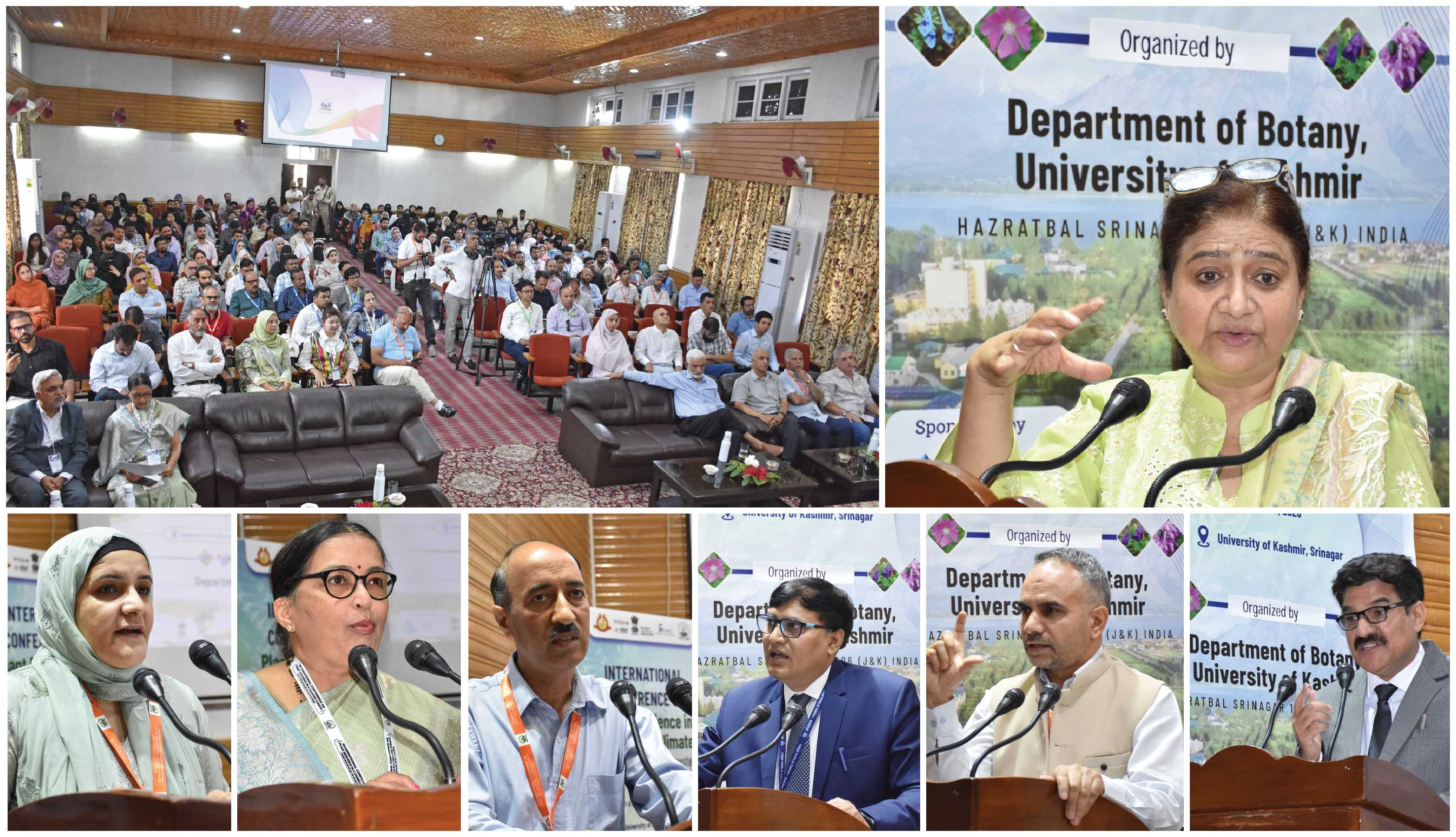
Srinagar, Sep 7: The Department of Botany, University of Kashmir (KU), on Monday inaugurated a two-day international conference on “Plant Resilience in a Changing Climate: From Molecules to Ecosystem”, bringing together scientists, academicians, researchers and young scholars to examine the growing impact of climate change on plants, agriculture and natural ecosystems, particularly in fragile Himalayan regions.
Organised by the Department of Botany in academic collaboration with Penn State University, USA, the conference is sponsored under the Scheme for Promotion of Academic and Research Collaboration (SPARC) of the Ministry of Education, Government of India, and co-sponsored by ANRF and DBT.
The conference aims to strengthen scientific collaboration and provide a platform for researchers to exchange knowledge, share emerging findings and explore innovative approaches to enhancing plant resilience under changing climatic conditions.
Addressing the inaugural session, KU Vice-Chancellor Prof Nilofer Khan said the impacts of climate change were becoming increasingly evident worldwide and required coordinated scientific and societal responses.
She said universities and research institutions have a vital role in generating knowledge that can help communities and ecosystems adapt to rapidly changing environmental conditions.
Highlighting the vulnerability of the Himalayan region, Prof Khan stressed the need for focused research on plant resilience and ecosystem stability.
She called for translating scientific knowledge into practical interventions, ranging from seed improvement and appropriate cultivation practices to broader sustainable approaches, while strengthening national and international research partnerships.
KU Dean Research Prof Bashir Ahmad Ganai, in his special remarks, said climate change had implications extending beyond the natural environment and must be examined within a broader social and developmental context.
He emphasised the importance of rigorous scientific research to understand changes in natural systems and environmental variations and their wider consequences.
Dr Mahendra Kumar Verma, Director, Central Institute of Temperate Horticulture, Srinagar, said visible changes were already being observed in the biological calendar of crops due to changing climatic conditions.
Referring to shifts in harvesting periods and their impact on the storage life and quality of agricultural produce, he called for a reassessment of existing practices and greater use of technology and predictive modelling to prepare the agriculture and horticulture sectors for emerging climate realities.
Head, Department of Botany, KU, and Conference Convener Prof Manzoor Ahmad Shah said the conference connects research on plant resilience across different levels of biological organisation—from molecules and genes to populations, communities and ecosystems.
He said understanding these interconnected processes was essential to addressing the complexity of climate change and developing effective scientific responses.
Conference organiser Dr Riffat John welcomed the guests and participants and outlined the objectives of the event. She said the conference was conceived as a platform for researchers and students to interact with experts, exchange scientific ideas and explore interdisciplinary approaches to plant resilience and climate sustainability.
The inaugural proceedings were conducted by Prof Anzar A. Khuroo of the Department of Botany, while Dr Neela Yennawar, co-organiser from Penn State University, proposed the vote of thanks.
The two-day conference features keynote and invited lectures, scientific sessions, flash talks, student-scientist interactions and poster presentations, besides a valedictory session and prize-distribution ceremony.



Srinagar, Sep 7: The Department of Botany, University of Kashmir (KU), on Monday inaugurated a two-day international conference on “Plant Resilience in a Changing Climate: From Molecules to Ecosystem”, bringing together scientists, academicians, researchers and young scholars to examine the growing impact of climate change on plants, agriculture and natural ecosystems, particularly in fragile Himalayan regions.
Organised by the Department of Botany in academic collaboration with Penn State University, USA, the conference is sponsored under the Scheme for Promotion of Academic and Research Collaboration (SPARC) of the Ministry of Education, Government of India, and co-sponsored by ANRF and DBT.
The conference aims to strengthen scientific collaboration and provide a platform for researchers to exchange knowledge, share emerging findings and explore innovative approaches to enhancing plant resilience under changing climatic conditions.
Addressing the inaugural session, KU Vice-Chancellor Prof Nilofer Khan said the impacts of climate change were becoming increasingly evident worldwide and required coordinated scientific and societal responses.
She said universities and research institutions have a vital role in generating knowledge that can help communities and ecosystems adapt to rapidly changing environmental conditions.
Highlighting the vulnerability of the Himalayan region, Prof Khan stressed the need for focused research on plant resilience and ecosystem stability.
She called for translating scientific knowledge into practical interventions, ranging from seed improvement and appropriate cultivation practices to broader sustainable approaches, while strengthening national and international research partnerships.
KU Dean Research Prof Bashir Ahmad Ganai, in his special remarks, said climate change had implications extending beyond the natural environment and must be examined within a broader social and developmental context.
He emphasised the importance of rigorous scientific research to understand changes in natural systems and environmental variations and their wider consequences.
Dr Mahendra Kumar Verma, Director, Central Institute of Temperate Horticulture, Srinagar, said visible changes were already being observed in the biological calendar of crops due to changing climatic conditions.
Referring to shifts in harvesting periods and their impact on the storage life and quality of agricultural produce, he called for a reassessment of existing practices and greater use of technology and predictive modelling to prepare the agriculture and horticulture sectors for emerging climate realities.
Head, Department of Botany, KU, and Conference Convener Prof Manzoor Ahmad Shah said the conference connects research on plant resilience across different levels of biological organisation—from molecules and genes to populations, communities and ecosystems.
He said understanding these interconnected processes was essential to addressing the complexity of climate change and developing effective scientific responses.
Conference organiser Dr Riffat John welcomed the guests and participants and outlined the objectives of the event. She said the conference was conceived as a platform for researchers and students to interact with experts, exchange scientific ideas and explore interdisciplinary approaches to plant resilience and climate sustainability.
The inaugural proceedings were conducted by Prof Anzar A. Khuroo of the Department of Botany, while Dr Neela Yennawar, co-organiser from Penn State University, proposed the vote of thanks.
The two-day conference features keynote and invited lectures, scientific sessions, flash talks, student-scientist interactions and poster presentations, besides a valedictory session and prize-distribution ceremony.

© Copyright 2023 brighterkashmir.com All Rights Reserved. Quantum Technologies