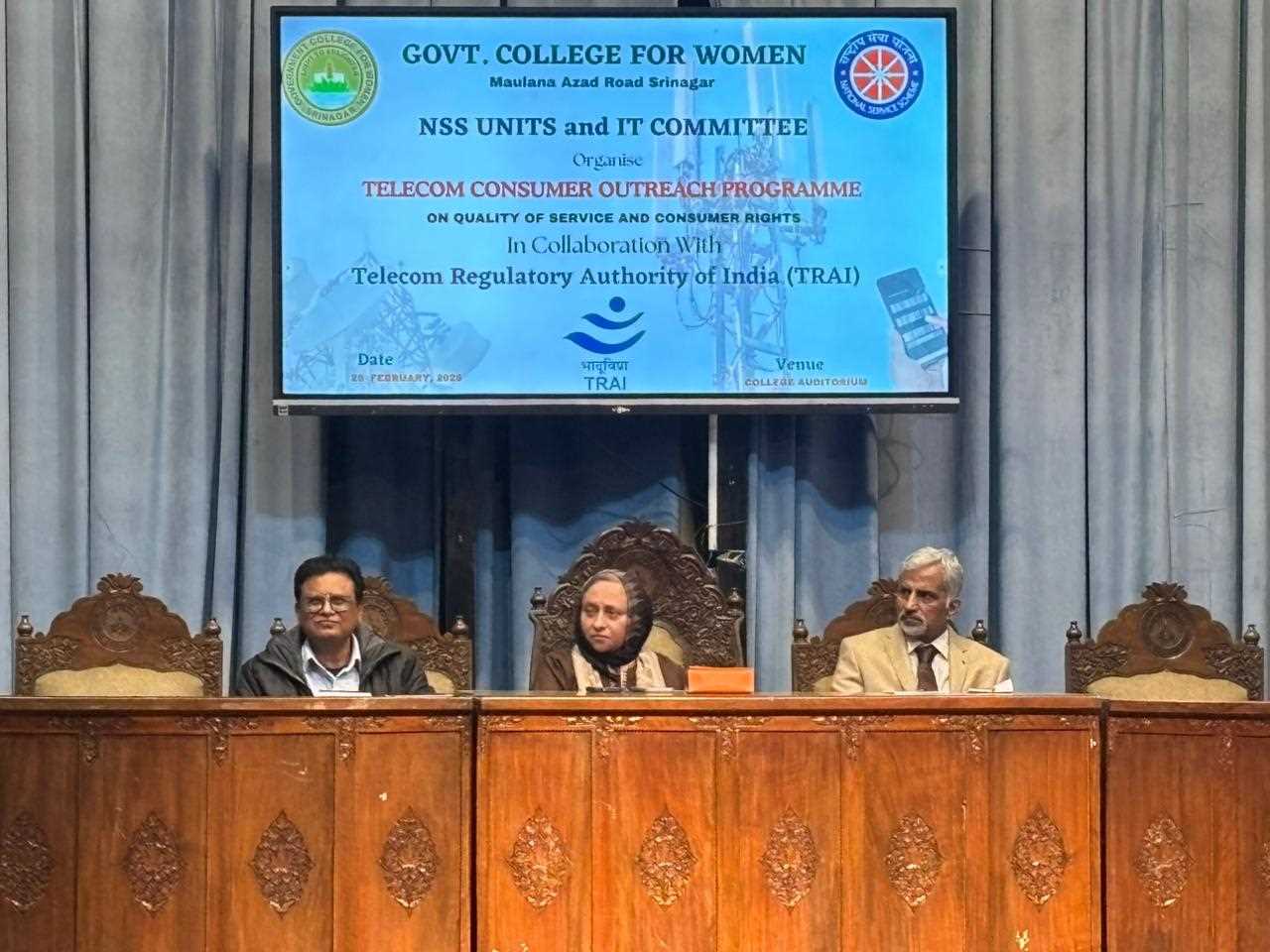
Department of Communication and Journalism (DCJ), Central University of Kashmir (CUKashmir), organized a round table discussion on media ownership, at Tulmulla campus here Thursday.
Guest of honour, Dr. Ahsanul Haq Chishti, Addtl Sec to the Government and CEO of the Wular-Manasbal Development Authority (WMDA) gave valuable insights into the evolving patterns of media consolidation and their broader impact. Highlighting global trends, Dr. Chishti remarked that in the United States, the 20 largest newspaper companies control more than half of the total readership. Citing big media moguls/conglomerates and their expansion through broadcasting and print, Dr. Chishti underlined how concentrated ownership can shape political and public discourse.
He explained that while the media sector has expanded exponentially in our country, ownership has become increasingly consolidated. He cautioned that “concentration of media ownership in the hands of a few individuals or corporations poses a potential threat to freedom of speech and diversity of opinion.” “Such concentration may enable owners to influence editorial policies in ways that protect their interests and create one-sided narratives.”
In his presidential remarks, Prof. Shahid Rasool, Dean Academic Affairs and Dean, School of Media Studies, emphasized the importance of media as one of the four pillars of democracy, alongside the Legislature, Executive, and Judiciary. He stated that “democracy thrives only when these pillars function independently.” He observed that ownership concentration often leads to “homogenization, as corporations controlling multiple platforms tend to promote similar content to maximize reach, thereby reducing diversity of perspectives and alternative narratives.”
Earlier, Dr. Arif Nazir, HoD, DCJ gave his welcome address. The discussion was facilitated by Dr. Nookaraju Bendukurthi and Dr. John Babu, Sr Asst Profs.
Dr. Asif Khan, Sr Asst Prof proposed the vote of thanks.

Department of Communication and Journalism (DCJ), Central University of Kashmir (CUKashmir), organized a round table discussion on media ownership, at Tulmulla campus here Thursday.
Guest of honour, Dr. Ahsanul Haq Chishti, Addtl Sec to the Government and CEO of the Wular-Manasbal Development Authority (WMDA) gave valuable insights into the evolving patterns of media consolidation and their broader impact. Highlighting global trends, Dr. Chishti remarked that in the United States, the 20 largest newspaper companies control more than half of the total readership. Citing big media moguls/conglomerates and their expansion through broadcasting and print, Dr. Chishti underlined how concentrated ownership can shape political and public discourse.
He explained that while the media sector has expanded exponentially in our country, ownership has become increasingly consolidated. He cautioned that “concentration of media ownership in the hands of a few individuals or corporations poses a potential threat to freedom of speech and diversity of opinion.” “Such concentration may enable owners to influence editorial policies in ways that protect their interests and create one-sided narratives.”
In his presidential remarks, Prof. Shahid Rasool, Dean Academic Affairs and Dean, School of Media Studies, emphasized the importance of media as one of the four pillars of democracy, alongside the Legislature, Executive, and Judiciary. He stated that “democracy thrives only when these pillars function independently.” He observed that ownership concentration often leads to “homogenization, as corporations controlling multiple platforms tend to promote similar content to maximize reach, thereby reducing diversity of perspectives and alternative narratives.”
Earlier, Dr. Arif Nazir, HoD, DCJ gave his welcome address. The discussion was facilitated by Dr. Nookaraju Bendukurthi and Dr. John Babu, Sr Asst Profs.
Dr. Asif Khan, Sr Asst Prof proposed the vote of thanks.

© Copyright 2023 brighterkashmir.com All Rights Reserved. Quantum Technologies