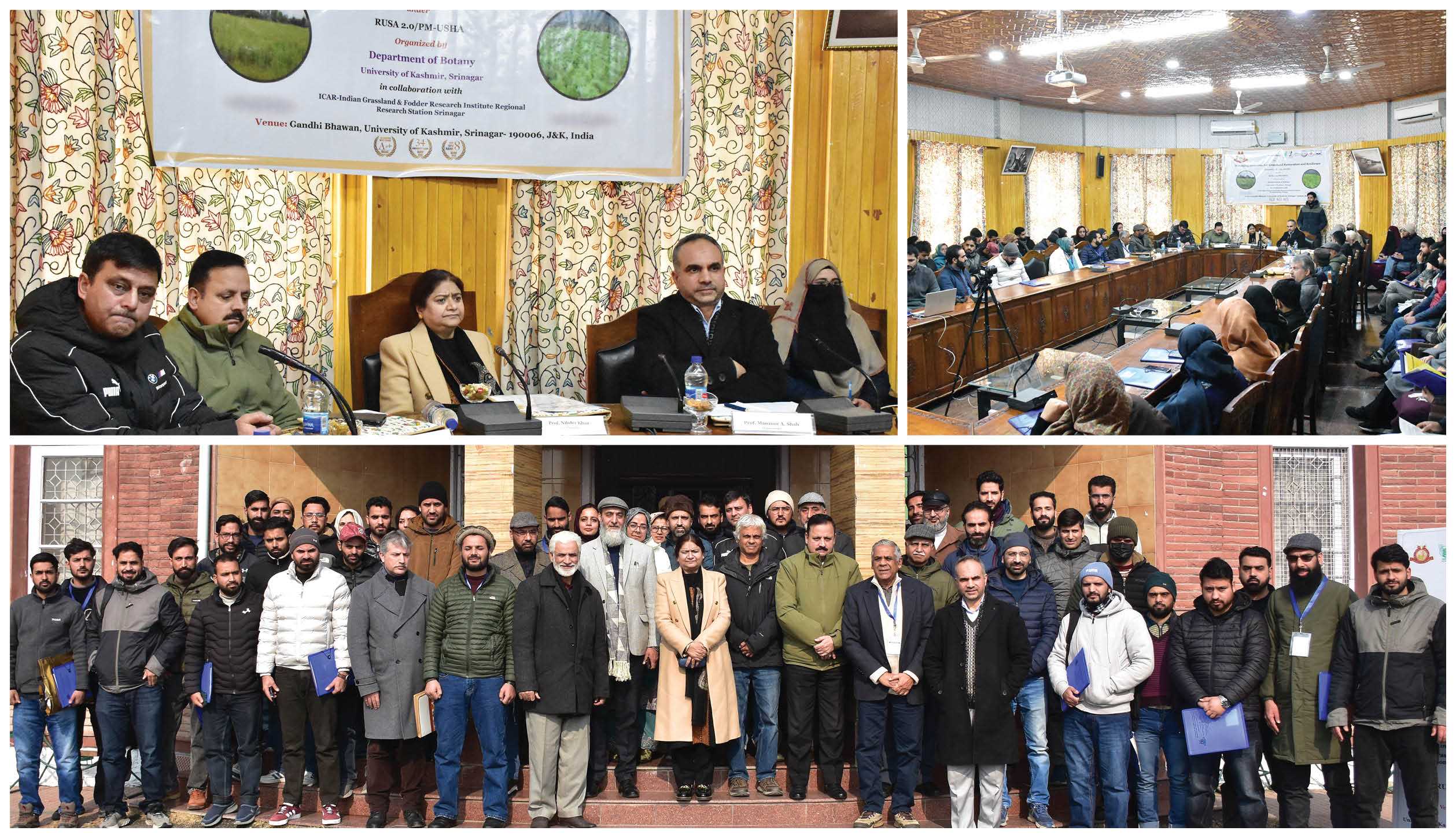
The Department of Botany, University of Kashmir (KU), on Tuesday began a two-day workshop titled “Managing Invasions for Grassland Restoration and Resilience” under the RUSA 2.0 project in collaboration with ICAR -Indian Grassland & Research Fodder Institute, Regional Research Station Srinagar, at the Main Campus.
The workshop aims to examine the ecological integrity of grasslands, assess the threats posed by invasive species, and identify practical restoration and management strategies.
In her address at the inaugural session, Vice-Chancellor KU, Prof. Nilofer Khan, said, “Grasslands are among the most threatened ecosystems, yet they remain critical for biodiversity, livelihoods, and climate resilience. Universities must play a proactive role in generating region-specific knowledge and solutions for their conservation.”
Registrar, KU, Prof. Naseer Iqbal highlighted the importance of institutional support and capacity-building initiatives in strengthening research-led approaches to ecological conservation. Dean, School of Biological Sciences, KU, Prof. Abdul Hamid Wani, noted that interdisciplinary research and collaboration are essential for addressing complex ecological challenges such as grassland degradation.
Head, Department of Botany, KU, Prof. Aijaz Wani, said that the workshop provides a platform for researchers, practitioners, and students to engage with contemporary issues related to grassland ecology and management.
The inaugural session also featured thematic addresses by domain experts focusing on the socio-ecological dimensions of grasslands. Director, Sheep Husbandry, Kashmir, Dr. Rafiq A. Shah, highlighted the role of grasslands in ensuring fodder security and maintaining soil fertility. Dr. G. Balachander, CEO, Krishi Bounty Biotech, Bangalore, discussed the relationship between grasslands, pastoralist livelihoods, and nature-based solutions (NbS). Dr. Mahesh Sankaran, NCBS, Bangalore, spoke on grassland science and ecosystem resilience, emphasising the need for long-term ecological research to strengthen adaptive management strategies.
Earlier, Coordinator of the workshop, Prof. Manzoor Shah, in his welcome address, outlined the objectives of the programme and stressed the relevance of local and regional perspectives in grassland restoration efforts.
The two-day workshop features expert sessions, field visit, and panel discussions on grassland ecology, invasive species dynamics, restoration practices, resilience-building measures, and policy frameworks relevant to grassland management. It is being attended by academic experts, delegates, research scholars and students.

The Department of Botany, University of Kashmir (KU), on Tuesday began a two-day workshop titled “Managing Invasions for Grassland Restoration and Resilience” under the RUSA 2.0 project in collaboration with ICAR -Indian Grassland & Research Fodder Institute, Regional Research Station Srinagar, at the Main Campus.
The workshop aims to examine the ecological integrity of grasslands, assess the threats posed by invasive species, and identify practical restoration and management strategies.
In her address at the inaugural session, Vice-Chancellor KU, Prof. Nilofer Khan, said, “Grasslands are among the most threatened ecosystems, yet they remain critical for biodiversity, livelihoods, and climate resilience. Universities must play a proactive role in generating region-specific knowledge and solutions for their conservation.”
Registrar, KU, Prof. Naseer Iqbal highlighted the importance of institutional support and capacity-building initiatives in strengthening research-led approaches to ecological conservation. Dean, School of Biological Sciences, KU, Prof. Abdul Hamid Wani, noted that interdisciplinary research and collaboration are essential for addressing complex ecological challenges such as grassland degradation.
Head, Department of Botany, KU, Prof. Aijaz Wani, said that the workshop provides a platform for researchers, practitioners, and students to engage with contemporary issues related to grassland ecology and management.
The inaugural session also featured thematic addresses by domain experts focusing on the socio-ecological dimensions of grasslands. Director, Sheep Husbandry, Kashmir, Dr. Rafiq A. Shah, highlighted the role of grasslands in ensuring fodder security and maintaining soil fertility. Dr. G. Balachander, CEO, Krishi Bounty Biotech, Bangalore, discussed the relationship between grasslands, pastoralist livelihoods, and nature-based solutions (NbS). Dr. Mahesh Sankaran, NCBS, Bangalore, spoke on grassland science and ecosystem resilience, emphasising the need for long-term ecological research to strengthen adaptive management strategies.
Earlier, Coordinator of the workshop, Prof. Manzoor Shah, in his welcome address, outlined the objectives of the programme and stressed the relevance of local and regional perspectives in grassland restoration efforts.
The two-day workshop features expert sessions, field visit, and panel discussions on grassland ecology, invasive species dynamics, restoration practices, resilience-building measures, and policy frameworks relevant to grassland management. It is being attended by academic experts, delegates, research scholars and students.
© Copyright 2023 brighterkashmir.com All Rights Reserved. Quantum Technologies