11-11-2026     3 رجب 1440

National Education Conclave 2026 held at Government College of Education Srinagar

November 11, 2026 | BK NEWS SERVICE

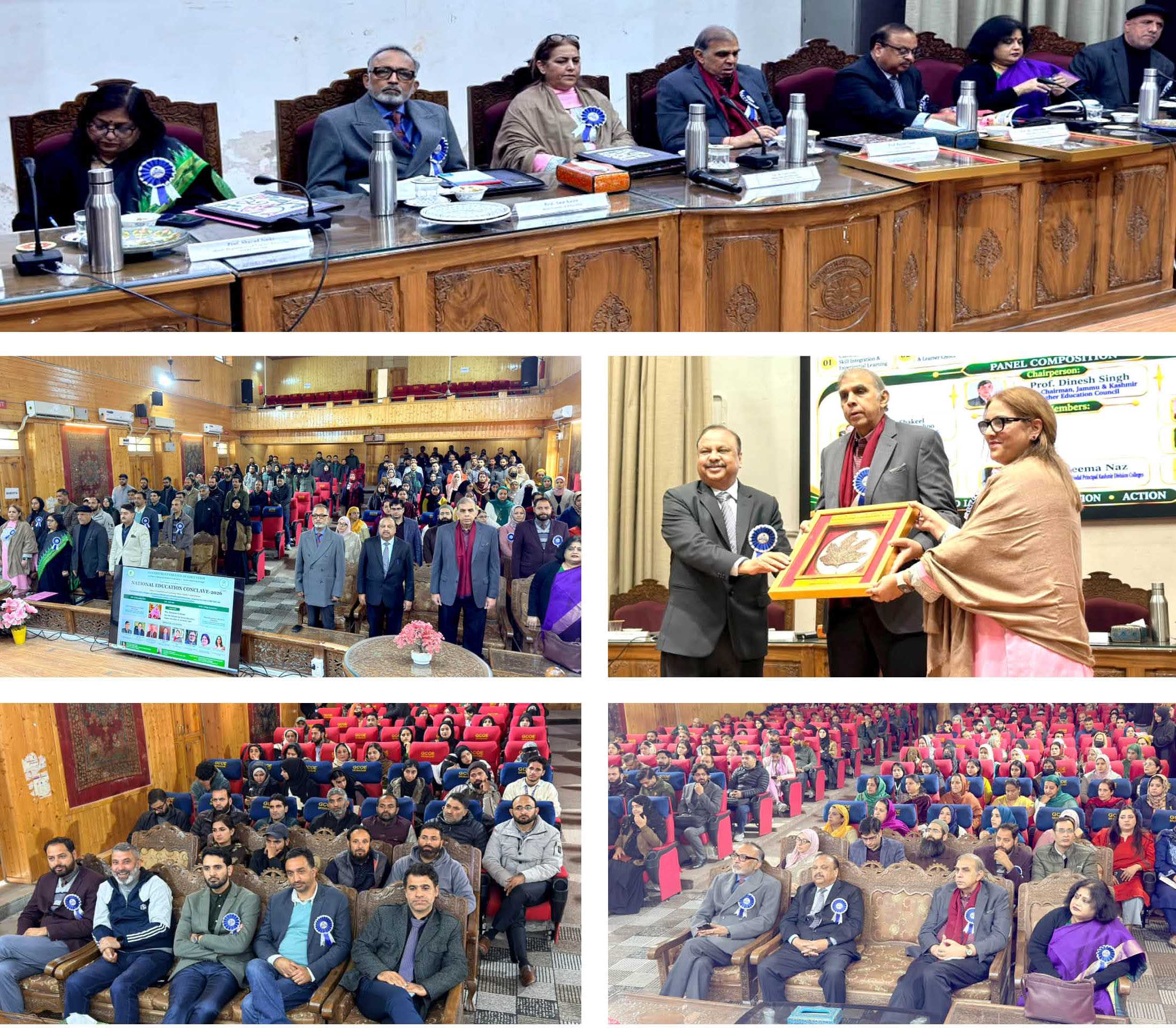
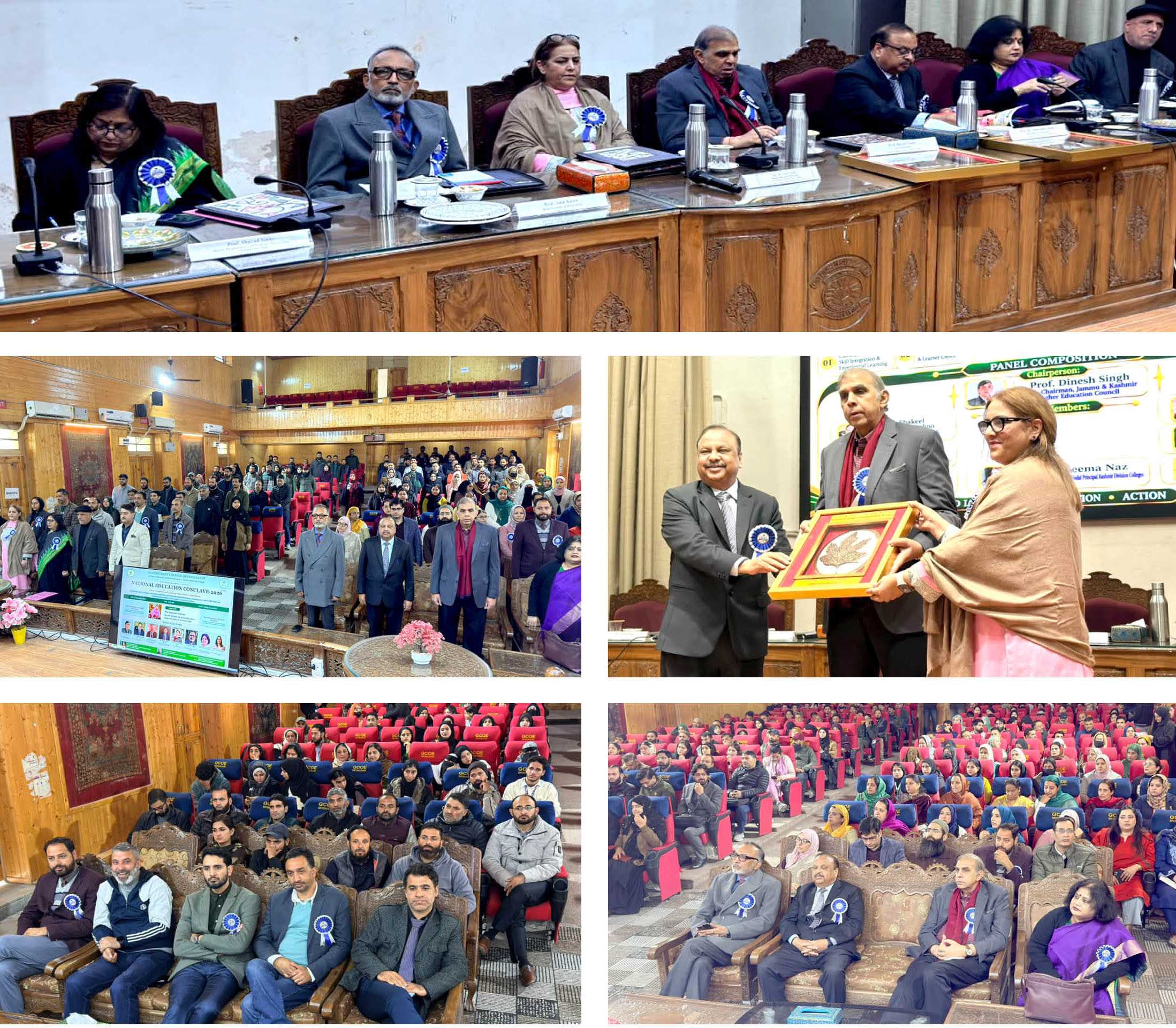
 The Innovation and Action Research Cell of the Government College of Education (IASE), Cluster University Srinagar, organized the National Education Conclave-2026 today.

Conceived as a premier platform for policy dialogue, instructional reflection, and actionable recommendations, the conclave aimed to bridge the visionary framework of the National Education Policy (NEP) 2020 with the implementation realities and strategic priorities of Jammu & Kashmir.

The event brought together eminent policymakers, educational administrators, and scholars  from across the country to deliberate on two pivotal thematic tracks: “How far have the structural and curricular reforms envisaged under NEP 2020 translated into institutional practice?” in Higher Education, and “Competency-Based Education, Holistic Progress Card and Learner Development” in School Education.

The inaugural session commenced with the solemn rendering of the National Song and the National Anthem, and was attended by  Prof. Dinesh Singh, Vice Chairman, J&K Higher Education Council; Prof. (Dr.) Mohammad Mobin, Vice Chancellor, Cluster University Srinagar; Prof. (Dr.) Seema Naz, Principal of the host college, Nodal Principal, Kashmir Division Colleges; Prof. (Dr.) Syed Wilayat Hussain Rizvi, Registrar, Cluster University Srinagar; Prof. (Dr.) Khurshid Ahmad Mir, Controller of Examinations, Cluster University Srinagar; Prof. Aarti Srivastava, Professor & Head, Department of Higher & Professional Education, NIEPA; Prof. Sharad Sinha, Head, Department of Teacher Education, NCERT, New Delhi; and Prof. Amit Kauts, Dean, Faculty of Education, GNDU, Amritsar.

The Chief Guest, Prof. Dinesh Singh, Vice Chairman, Higher Education Council, J&K, delivered an inspiring keynote address reflecting deeply on the real meaning and purpose of education. He observed that true education is achieved when an individual begins to hear their own “inner drumbeat” and learns to march in tune with it. Drawing vivid examples from the lives and journeys of Mahatma Gandhi, Sachin Tendulkar, and Amitabh Bachchan, he shed light on how tuning into one’s inner calling and cultivating intrinsic passions is what ultimately guarantees enduring excellence and success in life. While accentuating the philosophy behind progressive academic frameworks, Prof. Singh urged educational institutions to orient students toward real-world problems. He emphasized that students must acquaint themselves directly with societal and industry challenges, stressing that learning to work collaboratively in groups to confront and solve these challenges constitutes the true essence of 21st-century education.

Addressing the gathering as the Guest of Honour, Prof. (Dr.) Mohammad Mobin, Vice Chancellor, Cluster University Srinagar, remarked that we are living in an unprecedented era of change where technology is rapidly overtaking conventional systems and demanding a fundamental restructuring of education. He stressed that the effective implementation of NEP-2020 must be firmly anchored in quality, relevance, high-impact research, and institutional collaboration. Emphasizing the central role of teacher education institutions in transforming the educational ecosystem, Prof. Mobin highlighted the essential shift in the role of the teacher from the traditional notion of a mere knowledge giver to that of a mentor, facilitator, guide, and researcher. He further underscored that realizing the mandates of NEP-2020 cannot be treated as the sole responsibility of governments and universities alone, but requires proactive, shared commitment from all educational stakeholders.

Earlier, Prof. Naz highlighted a major institutional milestone, sharing that the college has been granted official recognition by the National Council for Teacher Education (NCTE) to run B.Ed, M.Ed, Integrated B.Ed–M.Ed, and the flagship Integrated Teacher Education Programme (ITEP) across both B.Sc.–B.Ed. and B.A.–B.Ed. streams.

Fazl Illahi, Coordinator, Innovation and Action Research Cell, IASE, presented the National Conclave Rationale. He underscored that we are living in a rapidly shifting VUCA world, marked by pervasive volatility, uncertainty, complexity, and ambiguity, where Artificial Intelligence has profoundly disrupted conventional paradigms. In light of this transformation, he stressed the urgent necessity for teachers and teacher-educators to fundamentally rethink and recalibrate their professional roles to equip learners with the adaptability, resilience, and competencies needed to overcome the emerging challenges of this complex landscape.

A major highlight of the inaugural session was the formal release of the college newsletter, Cascade, alongside the research journal, Inquiry, unveiled jointly by the Chief Guest, Guest of Honour, and the faculty of IASE. 

Meanwhile, two Panel Discussions were also held. The first, chaired by Prof. Dinesh Singh, Vice Chairman, Higher Education Council, J&K, deliberated on translating structural and curricular reforms under NEP 2020 into institutional practice, focusing on research, digitisation, faculty development, internships, employability, institutional autonomy and industry-academia collaboration.

The second panel, chaired by Prof. Sharad Sinha, Head, Department of Teacher Education, NCERT, New Delhi, focused on competency-based education, Holistic Progress Cards and learner development. The discussion highlighted the transition from rote-based examinations towards continuous, formative and learner-centric assessment, experiential learning, inclusive education and strengthening teachers' capacities.

The panellists emphasised the need for stronger institutional collaboration, adequate infrastructure, teacher training and meaningful engagement of parents and industry to ensure effective implementation of NEP 2020. The discussions also underscored the importance of nurturing critical thinking, creativity, emotional resilience and practical competencies among learners.

The conclave concluded with a valedictory session, during which certificates were distributed among panellists, speakers and members of the organising committee.

Prof. (Dr.) Seema Naz, Principal, IASE, Srinagar, appreciated the panellists and participants and emphasised that educational reforms must translate into meaningful institutional and classroom-level practices for the holistic development of learners.

BREAKING NEWS

VIDEO

Twitter

Facebook

National Education Conclave 2026 held at Government College of Education Srinagar

November 11, 2026 | BK NEWS SERVICE

 The Innovation and Action Research Cell of the Government College of Education (IASE), Cluster University Srinagar, organized the National Education Conclave-2026 today.

Conceived as a premier platform for policy dialogue, instructional reflection, and actionable recommendations, the conclave aimed to bridge the visionary framework of the National Education Policy (NEP) 2020 with the implementation realities and strategic priorities of Jammu & Kashmir.

The event brought together eminent policymakers, educational administrators, and scholars  from across the country to deliberate on two pivotal thematic tracks: “How far have the structural and curricular reforms envisaged under NEP 2020 translated into institutional practice?” in Higher Education, and “Competency-Based Education, Holistic Progress Card and Learner Development” in School Education.

The inaugural session commenced with the solemn rendering of the National Song and the National Anthem, and was attended by  Prof. Dinesh Singh, Vice Chairman, J&K Higher Education Council; Prof. (Dr.) Mohammad Mobin, Vice Chancellor, Cluster University Srinagar; Prof. (Dr.) Seema Naz, Principal of the host college, Nodal Principal, Kashmir Division Colleges; Prof. (Dr.) Syed Wilayat Hussain Rizvi, Registrar, Cluster University Srinagar; Prof. (Dr.) Khurshid Ahmad Mir, Controller of Examinations, Cluster University Srinagar; Prof. Aarti Srivastava, Professor & Head, Department of Higher & Professional Education, NIEPA; Prof. Sharad Sinha, Head, Department of Teacher Education, NCERT, New Delhi; and Prof. Amit Kauts, Dean, Faculty of Education, GNDU, Amritsar.

The Chief Guest, Prof. Dinesh Singh, Vice Chairman, Higher Education Council, J&K, delivered an inspiring keynote address reflecting deeply on the real meaning and purpose of education. He observed that true education is achieved when an individual begins to hear their own “inner drumbeat” and learns to march in tune with it. Drawing vivid examples from the lives and journeys of Mahatma Gandhi, Sachin Tendulkar, and Amitabh Bachchan, he shed light on how tuning into one’s inner calling and cultivating intrinsic passions is what ultimately guarantees enduring excellence and success in life. While accentuating the philosophy behind progressive academic frameworks, Prof. Singh urged educational institutions to orient students toward real-world problems. He emphasized that students must acquaint themselves directly with societal and industry challenges, stressing that learning to work collaboratively in groups to confront and solve these challenges constitutes the true essence of 21st-century education.

Addressing the gathering as the Guest of Honour, Prof. (Dr.) Mohammad Mobin, Vice Chancellor, Cluster University Srinagar, remarked that we are living in an unprecedented era of change where technology is rapidly overtaking conventional systems and demanding a fundamental restructuring of education. He stressed that the effective implementation of NEP-2020 must be firmly anchored in quality, relevance, high-impact research, and institutional collaboration. Emphasizing the central role of teacher education institutions in transforming the educational ecosystem, Prof. Mobin highlighted the essential shift in the role of the teacher from the traditional notion of a mere knowledge giver to that of a mentor, facilitator, guide, and researcher. He further underscored that realizing the mandates of NEP-2020 cannot be treated as the sole responsibility of governments and universities alone, but requires proactive, shared commitment from all educational stakeholders.

Earlier, Prof. Naz highlighted a major institutional milestone, sharing that the college has been granted official recognition by the National Council for Teacher Education (NCTE) to run B.Ed, M.Ed, Integrated B.Ed–M.Ed, and the flagship Integrated Teacher Education Programme (ITEP) across both B.Sc.–B.Ed. and B.A.–B.Ed. streams.

Fazl Illahi, Coordinator, Innovation and Action Research Cell, IASE, presented the National Conclave Rationale. He underscored that we are living in a rapidly shifting VUCA world, marked by pervasive volatility, uncertainty, complexity, and ambiguity, where Artificial Intelligence has profoundly disrupted conventional paradigms. In light of this transformation, he stressed the urgent necessity for teachers and teacher-educators to fundamentally rethink and recalibrate their professional roles to equip learners with the adaptability, resilience, and competencies needed to overcome the emerging challenges of this complex landscape.

A major highlight of the inaugural session was the formal release of the college newsletter, Cascade, alongside the research journal, Inquiry, unveiled jointly by the Chief Guest, Guest of Honour, and the faculty of IASE. 

Meanwhile, two Panel Discussions were also held. The first, chaired by Prof. Dinesh Singh, Vice Chairman, Higher Education Council, J&K, deliberated on translating structural and curricular reforms under NEP 2020 into institutional practice, focusing on research, digitisation, faculty development, internships, employability, institutional autonomy and industry-academia collaboration.

The second panel, chaired by Prof. Sharad Sinha, Head, Department of Teacher Education, NCERT, New Delhi, focused on competency-based education, Holistic Progress Cards and learner development. The discussion highlighted the transition from rote-based examinations towards continuous, formative and learner-centric assessment, experiential learning, inclusive education and strengthening teachers' capacities.

The panellists emphasised the need for stronger institutional collaboration, adequate infrastructure, teacher training and meaningful engagement of parents and industry to ensure effective implementation of NEP 2020. The discussions also underscored the importance of nurturing critical thinking, creativity, emotional resilience and practical competencies among learners.

The conclave concluded with a valedictory session, during which certificates were distributed among panellists, speakers and members of the organising committee.

Prof. (Dr.) Seema Naz, Principal, IASE, Srinagar, appreciated the panellists and participants and emphasised that educational reforms must translate into meaningful institutional and classroom-level practices for the holistic development of learners.


  • Address: R.C 2 Quarters Press Enclave Near Pratap Park, Srinagar 190001.
  • Phone: 0194-2451076 , +91-941-940-0056 , +91-962-292-4716
  • Email: brighterkmr@gmail.com
Owner, Printer, Publisher, Editor: Farooq Ahmad Wani
Legal Advisor: M.J. Hubi
Printed at: Sangermal offset Printing Press Rangreth ( Budgam)
Published from: Gulshanabad Chraresharief Budgam
RNI No.: JKENG/2010/33802
Office No’s: 0194-2451076
Mobile No’s 9419400056, 9622924716 ,7006086442
Postal Regd No: SK/135/2010-2019
POST BOX NO: 1001
Administrative Office: R.C 2 Quarters Press Enclave Near Pratap Park ( Srinagar -190001)

© Copyright 2023 brighterkashmir.com All Rights Reserved. Quantum Technologies

Owner, Printer, Publisher, Editor: Farooq Ahmad Wani
Legal Advisor: M.J. Hubi
Printed at: Abid Enterprizes, Zainkote Srinagar
Published from: Gulshanabad Chraresharief Budgam
RNI No.: JKENG/2010/33802
Office No’s: 0194-2451076, 9622924716 , 9419400056
Postal Regd No: SK/135/2010-2019
Administrative Office: Abi Guzer Srinagar

© Copyright 2018 brighterkashmir.com All Rights Reserved.