Srinagar, Sep 8: The past decade has seen some of the most significant expansion of railway infrastructure in Jammu and Kashmir, culminating in the completion of the 272-km Udhampur-Srinagar-Baramulla Rail Link (USBRL), direct passenger connectivity between Jammu and Srinagar and the introduction of new freight movement into and out of the Kashmir Valley.
The most significant development has been the completion and commissioning of the USBRL in 2025. The project, constructed at a reported cost of around Rs 43,780 crore, includes 36 tunnels extending over 119 km and 943 bridges, providing an all-weather rail connection between the Kashmir Valley and the rest of the Indian railway network.
Among its most prominent structures is the 1,315-metre Chenab Rail Bridge, rising 359 metres above the Chenab River and described by the Railway Ministry as the world's highest railway arch bridge. The USBRL also includes the Anji Khad Bridge, India's first cable-stayed railway bridge.
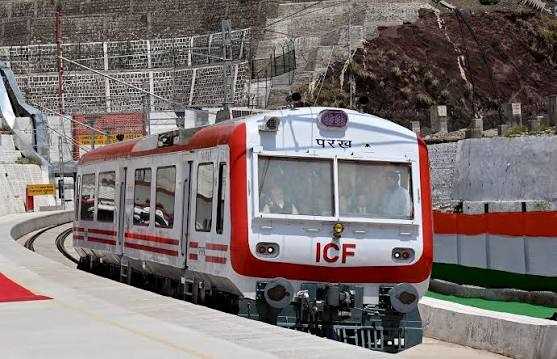
The project was preceded by the commissioning of the 48-km Banihal-Khari-Sumber-Sangaldan section in February 2024. At the same time, the 185.66-km Baramulla-Srinagar-Banihal-Sangaldan section was electrified and the Valley's first electric train was introduced.
The railway network was further expanded administratively with the creation of the Jammu Railway Division in January 2025. The Railway Ministry has also taken up redevelopment of Jammu Tawi, Shri Mata Vaishno Devi Katra, Udhampur and Budgam railway stations under the Amrit Bharat Station Scheme.
Passenger connectivity received another major push in 2025 with the introduction of Vande Bharat services between Shri Mata Vaishno Devi Katra and Srinagar. In April 2026, the service was extended to Jammu Tawi and expanded from eight to 20 coaches, creating a direct Jammu-Srinagar passenger service. Regular services on the extended route began on May 2, 2026.
The Railway Ministry said the four Jammu-Srinagar Vande Bharat services carried 44,727 passengers in their first 10 days of regular operation.
The impact has also extended to freight movement. According to the Railway Ministry, nearly two crore kilograms of apples had been transported from Kashmir to the rest of the country by April 2026. The Ministry also said cement, foodgrains, fertilisers, salt and milk were being transported into the region by rail, with improved logistics helping reduce the cost of essential commodities.
In August 2026, the Ministry said a Gati Shakti Multi-Modal Cargo Terminal had been commissioned in Samba, while in-principle approvals had been granted for terminals at Kathua, Anantnag and Jammu.
The Railway Ministry has also said that the entire existing broad-gauge railway network in Jammu and Kashmir has now been electrified, while new line and multi-tracking projects are being sanctioned and constructed with electrification.
Further expansion is also under preparation. The Ministry has sanctioned a Final Location Survey for a 190-km Jammu/Reasi-Poonch new railway line, while surveys are underway for a 78-km additional line between Jammu and Shri Mata Vaishno Devi Katra. A Detailed Project Report has also been prepared for the 216-km Jalandhar Cantt-Jammu Tawi third line.
For the Kashmir Valley, the Railway Ministry has prepared a DPR for the 118-km Qazigund-Srinagar-Budgam doubling project and another for a 40-km Baramulla-Uri new line.
The developments collectively mark a shift from the earlier railway network, which largely ended at Jammu for most of the country's long-distance passenger movement, to a system now providing direct rail access to the Kashmir Valley and increasingly supporting passenger, tourism and freight movement.

Srinagar, Sep 8: The past decade has seen some of the most significant expansion of railway infrastructure in Jammu and Kashmir, culminating in the completion of the 272-km Udhampur-Srinagar-Baramulla Rail Link (USBRL), direct passenger connectivity between Jammu and Srinagar and the introduction of new freight movement into and out of the Kashmir Valley.
The most significant development has been the completion and commissioning of the USBRL in 2025. The project, constructed at a reported cost of around Rs 43,780 crore, includes 36 tunnels extending over 119 km and 943 bridges, providing an all-weather rail connection between the Kashmir Valley and the rest of the Indian railway network.
Among its most prominent structures is the 1,315-metre Chenab Rail Bridge, rising 359 metres above the Chenab River and described by the Railway Ministry as the world's highest railway arch bridge. The USBRL also includes the Anji Khad Bridge, India's first cable-stayed railway bridge.
The project was preceded by the commissioning of the 48-km Banihal-Khari-Sumber-Sangaldan section in February 2024. At the same time, the 185.66-km Baramulla-Srinagar-Banihal-Sangaldan section was electrified and the Valley's first electric train was introduced.
The railway network was further expanded administratively with the creation of the Jammu Railway Division in January 2025. The Railway Ministry has also taken up redevelopment of Jammu Tawi, Shri Mata Vaishno Devi Katra, Udhampur and Budgam railway stations under the Amrit Bharat Station Scheme.
Passenger connectivity received another major push in 2025 with the introduction of Vande Bharat services between Shri Mata Vaishno Devi Katra and Srinagar. In April 2026, the service was extended to Jammu Tawi and expanded from eight to 20 coaches, creating a direct Jammu-Srinagar passenger service. Regular services on the extended route began on May 2, 2026.
The Railway Ministry said the four Jammu-Srinagar Vande Bharat services carried 44,727 passengers in their first 10 days of regular operation.
The impact has also extended to freight movement. According to the Railway Ministry, nearly two crore kilograms of apples had been transported from Kashmir to the rest of the country by April 2026. The Ministry also said cement, foodgrains, fertilisers, salt and milk were being transported into the region by rail, with improved logistics helping reduce the cost of essential commodities.
In August 2026, the Ministry said a Gati Shakti Multi-Modal Cargo Terminal had been commissioned in Samba, while in-principle approvals had been granted for terminals at Kathua, Anantnag and Jammu.
The Railway Ministry has also said that the entire existing broad-gauge railway network in Jammu and Kashmir has now been electrified, while new line and multi-tracking projects are being sanctioned and constructed with electrification.
Further expansion is also under preparation. The Ministry has sanctioned a Final Location Survey for a 190-km Jammu/Reasi-Poonch new railway line, while surveys are underway for a 78-km additional line between Jammu and Shri Mata Vaishno Devi Katra. A Detailed Project Report has also been prepared for the 216-km Jalandhar Cantt-Jammu Tawi third line.
For the Kashmir Valley, the Railway Ministry has prepared a DPR for the 118-km Qazigund-Srinagar-Budgam doubling project and another for a 40-km Baramulla-Uri new line.
The developments collectively mark a shift from the earlier railway network, which largely ended at Jammu for most of the country's long-distance passenger movement, to a system now providing direct rail access to the Kashmir Valley and increasingly supporting passenger, tourism and freight movement.
© Copyright 2023 brighterkashmir.com All Rights Reserved. Quantum Technologies