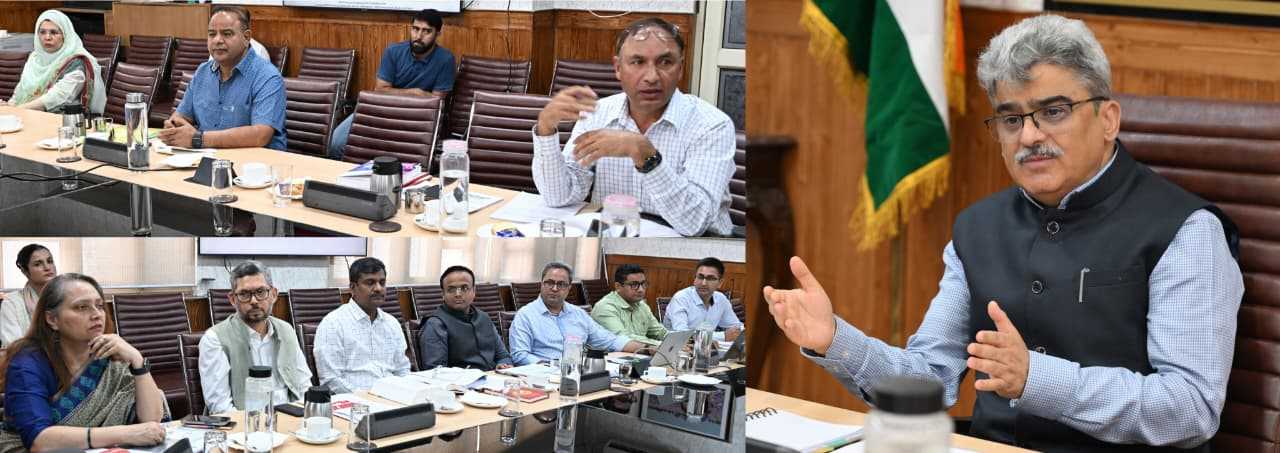
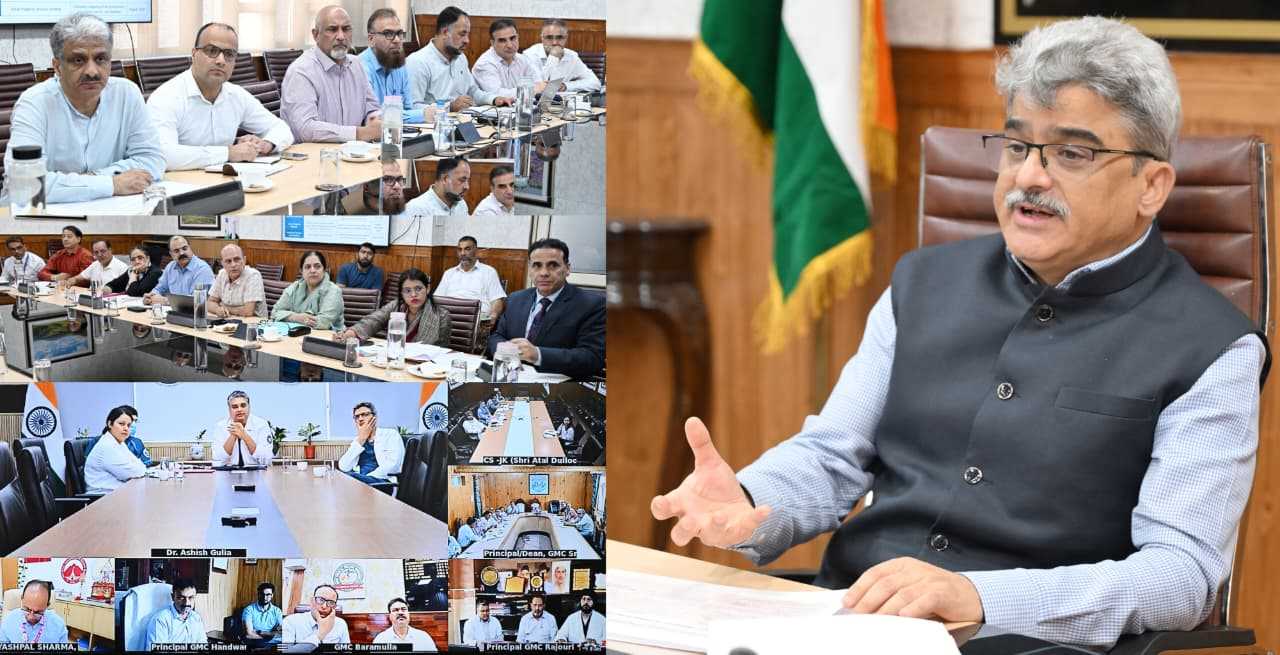
Chief Secretary, Atal Dulloo, today convened a meeting to evaluate the roadmap prepared by the Agriculture Production Department (APD) for promotion of commercial cultivation of Medicinal and Aromatic Plants (MAPs) in Jammu and Kashmir, aimed at unlocking the sector's vast economic potential and transforming the Union Territory to become a hub in high-value Himalayan medicinal plants.
The meeting was attended by Additional Chief Secretary, Agriculture Production Department; Vice Chancellors of SKUAST-Kashmir and SKUAST-Jammu; Commissioner Secretary, Forests; Principal Chief Conservator of Forests; MD, HADP; Director Agriculture, Kashmir/Jammu; Representatives from CSIR-IIIM, Jammu; Senior Faculty from Agriculture Universities and other senior officers of the Agriculture Production Department, Forest Department.
The Chief Secretary observed that Jammu and Kashmir possesses immense natural advantages in terms of biodiversity, climate and availability of several high-value medicinal plant species which provide a strong foundation for developing a globally competitive medicinal plant economy.
He said the sector has enormous potential to diversify agriculture, enhance farmers' incomes, generate employment for rural youth and women, promote entrepreneurship and significantly strengthen the Union Territory's bio-economy.
He stressed that the roadmap should be implemented with clearly defined timelines, measurable outcomes. He directed the Agriculture Production Department to work in close coordination with the Forest Department, AYUSH, research institutions and the private sector to build a complete value chain from cultivation to global markets.
The Chief Secretary further underscored the importance of attracting private investment in cultivation, processing and value addition while ensuring scientific conservation of valuable medicinal plant resources. He called for adopting cluster-based cultivation models and facilitating stronger market linkages so that farmers receive higher returns from cultivation of medicinal and aromatic plants.
While speaking the ACS, Agriculture Production Department, Dr Ashish Chandra Verma outlined a comprehensive ₹150 Cr mission proposed to be implemented over six years for developing an integrated ecosystem encompassing conservation, scientific cultivation, quality planting material, research, processing, value addition, branding, marketing and exports of Medicinal and Aromatic Plants.
He further maintained that although Jammu and Kashmir possesses one of the richest repositories of Himalayan medicinal plants, its current contribution to the national MAP sector remains below potential due to limited organised cultivation, inadequate processing infrastructure, dependence on wild collection, fragmented marketing systems and limited industry participation. The roadmap seeks to address these challenges through a comprehensive strategy integrating conservation, cultivation, processing, research and marketing.
Detailing out further MD, HADP, Dr. Sagar Doifode Dattatray informed that the proposed mission comprises six major intervention areas, namely conservation and cultivation, establishment of processing infrastructure, branding and marketing, translational research and development, monitoring and evaluation, and capacity building of stakeholders.
Elaborating it, the MD made out that the roadmap proposes geo-spatial mapping of MAP-rich niche zones across Jammu and Kashmir, restoration of 1,500 hectares of degraded forest ecosystems, establishment of 51 specialised MAP nurseries, expansion of cultivation outside forest areas, strengthening of 225 Biodiversity Management Committees and financial support for 500 farmers to obtain Good Agricultural and Collection Practices (GACP) and Organic Certification.
Regarding value addition, it was informed that the mission envisages establishment of six primary processing centres in the private sector besides creation of two advanced extraction units too. These facilities would substantially strengthen processing capacity, improve product quality, reduce post-harvest losses and facilitate production of high-value herbal extracts and active pharmaceutical ingredients.
The meeting was further informed by the Nodal Officer, MAP in APD, Dr Abhimanyu that nearly 40 per cent of the total project cost has been earmarked for branding and marketing initiatives, including establishment of two FPO/MFP Parks, two mega MAP clusters in Public-Private Partnership mode, two model MAP villages, creation of an Export Promotion Cell, development of a dedicated digital marketing platform and constitution of a Herbal Innovation Fund to support 80 start-ups in the medicinal plants sector.
The presentation also highlighted proposals for development of scientifically validated cultivation technologies, standardisation of 40 Packages of Practices, screening of 40 medicinal plant species for active pharmaceutical ingredients, commercialisation of 40 APIs, filing of nine patents and conservation of nearly 165 medicinal plant species through collaborative research involving SKUAST-Jammu, SKUAST-Kashmir and CSIR-IIIM Jammu.
The Department informed the meeting that successful implementation of the roadmap is expected to expand the area under MAP cultivation to over 1,700 hectares, support establishment of 80 start-ups and 25 export-oriented enterprises, besides benefiting over 5,000 farmers and entrepreneurs directly while generating substantial indirect employment across the value chain.
The Chief Secretary reiterated that the proposed roadmap represents a transformative opportunity to harness Jammu and Kashmir's unique biodiversity for sustainable economic growth while ensuring scientific conservation of its invaluable medicinal plant wealth creating new avenues of prosperity for farmers, entrepreneurs and rural communities.

Chief Secretary, Atal Dulloo, today convened a meeting to evaluate the roadmap prepared by the Agriculture Production Department (APD) for promotion of commercial cultivation of Medicinal and Aromatic Plants (MAPs) in Jammu and Kashmir, aimed at unlocking the sector's vast economic potential and transforming the Union Territory to become a hub in high-value Himalayan medicinal plants.
The meeting was attended by Additional Chief Secretary, Agriculture Production Department; Vice Chancellors of SKUAST-Kashmir and SKUAST-Jammu; Commissioner Secretary, Forests; Principal Chief Conservator of Forests; MD, HADP; Director Agriculture, Kashmir/Jammu; Representatives from CSIR-IIIM, Jammu; Senior Faculty from Agriculture Universities and other senior officers of the Agriculture Production Department, Forest Department.
The Chief Secretary observed that Jammu and Kashmir possesses immense natural advantages in terms of biodiversity, climate and availability of several high-value medicinal plant species which provide a strong foundation for developing a globally competitive medicinal plant economy.
He said the sector has enormous potential to diversify agriculture, enhance farmers' incomes, generate employment for rural youth and women, promote entrepreneurship and significantly strengthen the Union Territory's bio-economy.
He stressed that the roadmap should be implemented with clearly defined timelines, measurable outcomes. He directed the Agriculture Production Department to work in close coordination with the Forest Department, AYUSH, research institutions and the private sector to build a complete value chain from cultivation to global markets.
The Chief Secretary further underscored the importance of attracting private investment in cultivation, processing and value addition while ensuring scientific conservation of valuable medicinal plant resources. He called for adopting cluster-based cultivation models and facilitating stronger market linkages so that farmers receive higher returns from cultivation of medicinal and aromatic plants.
While speaking the ACS, Agriculture Production Department, Dr Ashish Chandra Verma outlined a comprehensive ₹150 Cr mission proposed to be implemented over six years for developing an integrated ecosystem encompassing conservation, scientific cultivation, quality planting material, research, processing, value addition, branding, marketing and exports of Medicinal and Aromatic Plants.
He further maintained that although Jammu and Kashmir possesses one of the richest repositories of Himalayan medicinal plants, its current contribution to the national MAP sector remains below potential due to limited organised cultivation, inadequate processing infrastructure, dependence on wild collection, fragmented marketing systems and limited industry participation. The roadmap seeks to address these challenges through a comprehensive strategy integrating conservation, cultivation, processing, research and marketing.
Detailing out further MD, HADP, Dr. Sagar Doifode Dattatray informed that the proposed mission comprises six major intervention areas, namely conservation and cultivation, establishment of processing infrastructure, branding and marketing, translational research and development, monitoring and evaluation, and capacity building of stakeholders.
Elaborating it, the MD made out that the roadmap proposes geo-spatial mapping of MAP-rich niche zones across Jammu and Kashmir, restoration of 1,500 hectares of degraded forest ecosystems, establishment of 51 specialised MAP nurseries, expansion of cultivation outside forest areas, strengthening of 225 Biodiversity Management Committees and financial support for 500 farmers to obtain Good Agricultural and Collection Practices (GACP) and Organic Certification.
Regarding value addition, it was informed that the mission envisages establishment of six primary processing centres in the private sector besides creation of two advanced extraction units too. These facilities would substantially strengthen processing capacity, improve product quality, reduce post-harvest losses and facilitate production of high-value herbal extracts and active pharmaceutical ingredients.
The meeting was further informed by the Nodal Officer, MAP in APD, Dr Abhimanyu that nearly 40 per cent of the total project cost has been earmarked for branding and marketing initiatives, including establishment of two FPO/MFP Parks, two mega MAP clusters in Public-Private Partnership mode, two model MAP villages, creation of an Export Promotion Cell, development of a dedicated digital marketing platform and constitution of a Herbal Innovation Fund to support 80 start-ups in the medicinal plants sector.
The presentation also highlighted proposals for development of scientifically validated cultivation technologies, standardisation of 40 Packages of Practices, screening of 40 medicinal plant species for active pharmaceutical ingredients, commercialisation of 40 APIs, filing of nine patents and conservation of nearly 165 medicinal plant species through collaborative research involving SKUAST-Jammu, SKUAST-Kashmir and CSIR-IIIM Jammu.
The Department informed the meeting that successful implementation of the roadmap is expected to expand the area under MAP cultivation to over 1,700 hectares, support establishment of 80 start-ups and 25 export-oriented enterprises, besides benefiting over 5,000 farmers and entrepreneurs directly while generating substantial indirect employment across the value chain.
The Chief Secretary reiterated that the proposed roadmap represents a transformative opportunity to harness Jammu and Kashmir's unique biodiversity for sustainable economic growth while ensuring scientific conservation of its invaluable medicinal plant wealth creating new avenues of prosperity for farmers, entrepreneurs and rural communities.
© Copyright 2023 brighterkashmir.com All Rights Reserved. Quantum Technologies